
What OK VINE Covers in Oklahoma County
OK VINE is Oklahoma’s VINE service. The Oklahoma Attorney General describes it as a free, confidential, computer-assisted service available around the clock for offender information and automated notifications. Access is offered through VINELink, the VINELink mobile app, and the telephone number 1-877-654-8463.
The service receives custody or status information from participating Oklahoma criminal-justice agencies. That includes OCDC jail information and ODOC information for incarcerated people and probation or parole offenders. State materials identify events that can include transfer, escape, apprehension, release, and death. Availability of an event does not mean every record displays every field or that an alert predicts the exact hour of a future release.
Coverage follows the reporting agency. A result from OCDC describes the county record supplied to VINE. A result from ODOC describes state custody or supervision. Federal Bureau of Prisons records are outside VINELink and must be checked through BOP. The person’s physical location in Oklahoma County does not merge those systems.
Search Oklahoma County Inmates on VINELink
Gather the person’s full legal name, spelling variants, and an agency identifier if known. A booking number, DOC number, age, date of birth, charge, or case number can help separate people with similar names. The goal is a single matched record, not a broad list of names.
- Open VINELink and choose Oklahoma. Select the person or offender search rather than protective-order content.
- Enter the available full name or identifier. If the initial search fails, try a documented spelling variant, compound surname, hyphenation, or suffix.
- Narrow the results by reporting agency or location. For a county booking, look for OCDC or the relevant municipal jail. For a state sentence, look for ODOC.
- Compare the displayed identity details with the booking, DOC, or case information already known. Do not select the first close name without a second matching identifier.
- Open the matched record and note the reporting agency, custody label, location or event, identifier, and last-update language exactly as displayed.
- If there is no result, call VINE or the responsible agency. Silence can reflect spelling, participation, timing, a transfer gap, or the wrong custody system.
For a person whose custody path is unclear, the Oklahoma County released-inmate search sequence adds OCDC records, court dockets, ODOC, and federal checks. VINELink should remain one status source inside that larger verification chain.
What VINELink Shows for Oklahoma County
The exact interface can vary by web or app version and by the agency data supplied. Record labels should be copied literally. Do not turn a general status into a more specific legal conclusion.
| Field | What it means |
|---|---|
| Name or offender identifier | Helps match the record, but should be compared with another identity detail. |
| Reporting agency | Identifies the jail or corrections system that supplied the custody event. |
| Custody status | States the agency’s current public label, such as in custody or released. |
| Location or event | May identify a facility or a movement such as transfer, release, escape, or apprehension. |
| Update time | Shows how recent the displayed agency information is and helps reconcile conflicts. |
| Notification options | Lists the delivery methods and events available for that matched record. |
A “released” result means the reporting agency transmitted a release event. It does not establish why custody ended, prove a court acquittal, or rule out custody under another agency. A county release can be followed by state or federal custody.
The status also differs from a court disposition. A court can order bond reduction, dismissal, sentencing, or transport, while the jail completes the physical movement after its own checks. Likewise, parole means release from incarceration to supervision and is not the same as discharge from the state obligation. Read the public label and the agency that supplied it instead of replacing it with a broader term.
Read an Oklahoma County VINE Release Carefully
Compare the reporting agency first. If OCDC shows released and ODOC shows incarcerated, the likely explanation is a transfer from county to state custody. State incarceration continues even though the county booking ended. If OCDC shows released and the court docket contains a bond or pretrial order, the legal authority and jail event may support a community release, but the OCDC release record remains the best source for exact exit time and destination.
If VINE shows released while JailTracker still shows current OCDC custody, compare update times and call OCDC. The two systems may be processing the same event at different speeds, or the records may concern different bookings or people. An empty VINE search is also inconclusive. Search an exact or variant spelling and any identifier, then ask the reporting agency rather than declaring release.
Oklahoma’s VINELink Search Screen
The accompanying image from the official VINELink source documents the Oklahoma search and notification interface without displaying private notification details.
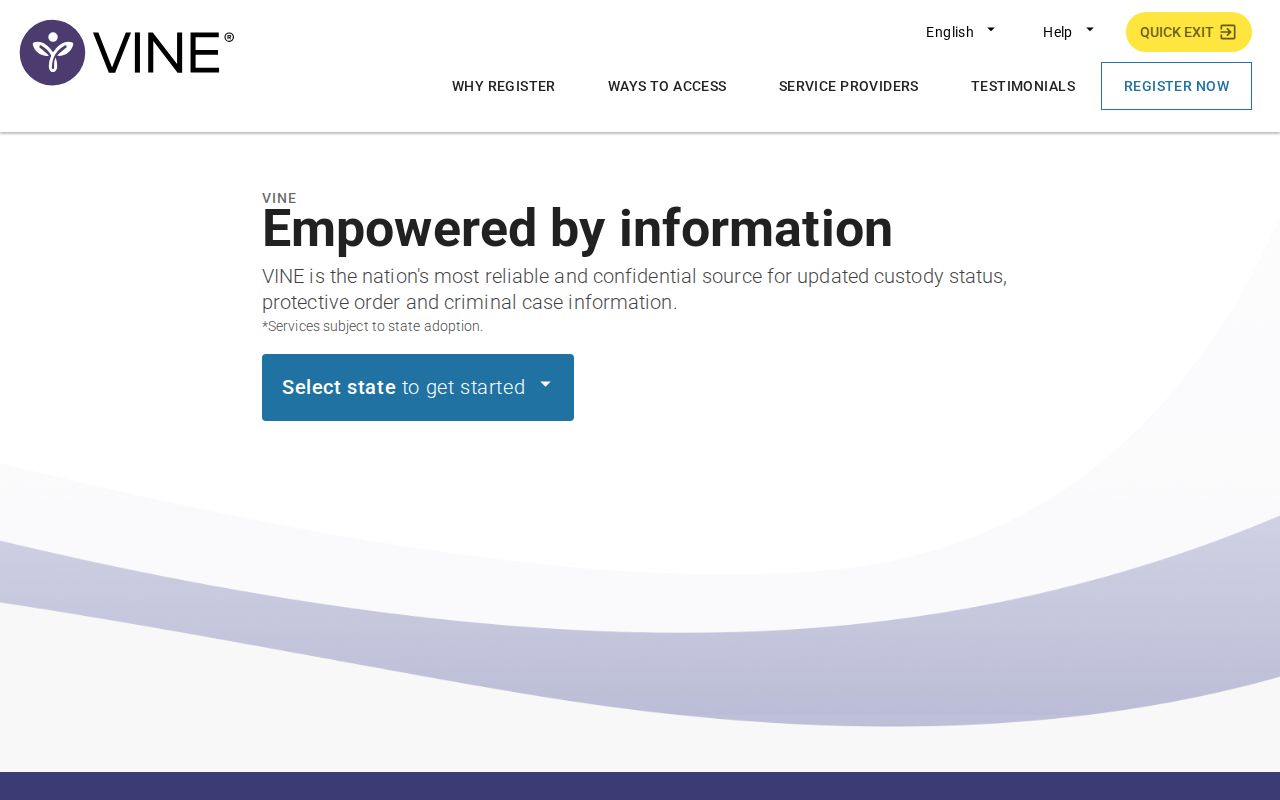
The screen is the starting point for a matched person search. It should not be used to capture an unrelated person’s private data, a real phone number, email address, confirmation code, or notification PIN.
Register for an Oklahoma County Release Notification
Registration should be completed from the correct person’s active record. The available delivery channels and event choices can differ, so review what the current interface offers instead of assuming that every method appears for each agency.
- Select the registration option from the matched record. The wording may appear as “Register for Notifications” or a close version.
- Choose an offered channel. Oklahoma sources list phone, text or SMS, email, in-app, and TTY among the available media.
- Enter and verify the requested destination. For telephone alerts, create the requested PIN. That PIN acknowledges or protects the automated call registration and is not the offender’s jail PIN.
- For web, email, or text delivery, complete any confirmation link or code requested by the interface. Never share the confirmation or PIN.
- Select the available custody events, check the person and reporting agency again, review the applicable terms, and finish registration.
- Save the confirmation and update each service if the phone number or email changes. Test settings when the interface supports it.
Register while the record is active when future notice is needed. VINE cannot retroactively guarantee an alert after the event has already occurred, and it cannot guarantee advance notice or an exact gate time.
OCDC’s Local Notification List Beyond VINE
OCDC adds a county-specific layer to the statewide service. Its official VINE page describes anonymous status checks through the toll-free number, VINELink website, and mobile app. It also directs users to call the OCDC front desk at 405-907-1930 to be added to the Victim Notification List.
These options should be treated as layered, not interchangeable. The OCDC list concerns county custody. OK VINE supplies automated status events reported by participating agencies. ODOC Victim Services addresses state custody movements and releases. The Oklahoma Pardon and Parole Board uses a separate notice process for parole proceedings and release to parole, and the Board warns that VINE does not replace that enrollment.
If a person moves from OCDC to ODOC, update or confirm registration with the correct state channel rather than assuming the county list follows the person. For state parole questions, use PPB and ODOC alongside VINE.
Oklahoma County VINELink Limits
VINELink does not cover BOP custody. A person at Federal Transfer Center Oklahoma City must be checked with the federal register number in the BOP Inmate Locator. Departing FTC Oklahoma City often means transfer within the federal system, not return to the community. ICE custody also has its own locator and follow-up process.
State sources identify another specific gap: if an ODOC inmate transfers to an Oklahoma Department of Mental Health facility, VINE is not active until the person returns to DOC custody. Automated records can also lag. No result or missed alert should be treated as proof of release.
Registries are separate as well. ODOC sex-offender and violent-offender registries apply only to people with a legal registration duty. They are not substitutes for a general VINE search, and absence from a registry says nothing about whether a person was released.
Notification itself has limits. VINE cannot replace an emergency or safety plan, and no alert should be described as a guaranteed advance warning. Save the registration confirmation, keep contact details current, and maintain the parallel agency enrollment that fits the custody system. A transfer can change which office controls the next event.
Resolve an Oklahoma County VINE Conflict
For OCDC, call 405-907-1930 or 405-504-6811 with the full name and booking number. Ask whether the person remains in county custody and whether the exit was a community release or transfer. The OCDC lobby is at 201 N. Shartel Ave., Oklahoma City, OK 73102, and is listed as open daily from 7 a.m. to 6 p.m.
For an ODOC record, use ODOC Offender Lookup and compare the DOC number, status, facility, sentence entries, parole or supervision fields, and any public date exactly as labeled. One discharged sentence does not always mean all state authority ended. ODOC Victim Services can address state movement or release notification, while PPB controls its separate parole-notice process.
The final account should state what each source says and when it was checked. That is more accurate than forcing different agency time stamps into a single unsupported conclusion.
When requesting a county record after a VINE event, provide the matched full name, booking number, approximate admission date, and case number. Ask OCDC for the release date and time, release type, and destination. For a state record, preserve the DOC number and check every sentence entry because one discharged count may not end all ODOC authority.