
Departures From FTC Oklahoma City
FTC Oklahoma City is an administrative-security federal facility with a transfer mission. Physical departure is therefore weak evidence of community release. A person may move to another BOP institution, travel under U.S. Marshals authority for a court proceeding, enter another custodial setting, or leave BOP custody after sentence completion or another lawful event. The destination and federal status determine which meaning applies.
A new BOP institution means federal incarceration continues. A locator result that reports “Released” or otherwise indicates the person is not in BOP custody, together with a past release date, supports a federal BOP release event. It does not by itself rule out another agency’s custody or a federal supervised-release term administered through the courts and probation system.
| Observed event | Meaning to test | Best source |
|---|---|---|
| Another BOP facility appears | Institutional transfer | BOP Inmate Locator |
| Temporary absence for court | USMS movement with custody continuing | Federal case and responsible federal authority |
| Past release date | Completed BOP custody event | BOP result plus federal case context |
| Supervised release order | Community supervision after imprisonment | Federal judgment and probation record |
| No result | Identity, date-coverage, processing, or custody question remains | Recheck register number and federal sources |
Search FTC Oklahoma City Custody
The BOP register number is the safest identifier. It follows the person across federal institutions and avoids confusing people with similar names. When the number is unavailable, search by exact name and compare age, race, sex, and other displayed identity details. Do not select a result based on a close name alone.
- Open the official BOP Inmate Locator and search by federal register number whenever possible.
- Verify the identity fields and note the result’s institution, custody language, and displayed release date.
- If another institution appears, treat the FTC departure as a transfer and follow the current BOP location.
- If a past release is shown, compare it with the federal judgment and any supervised-release term.
- Record the date of the lookup and resolve a no-result through federal sources rather than county or ODOC searches.
The BOP Inmate Locator is the official search for a federal prisoner or former federal prisoner.
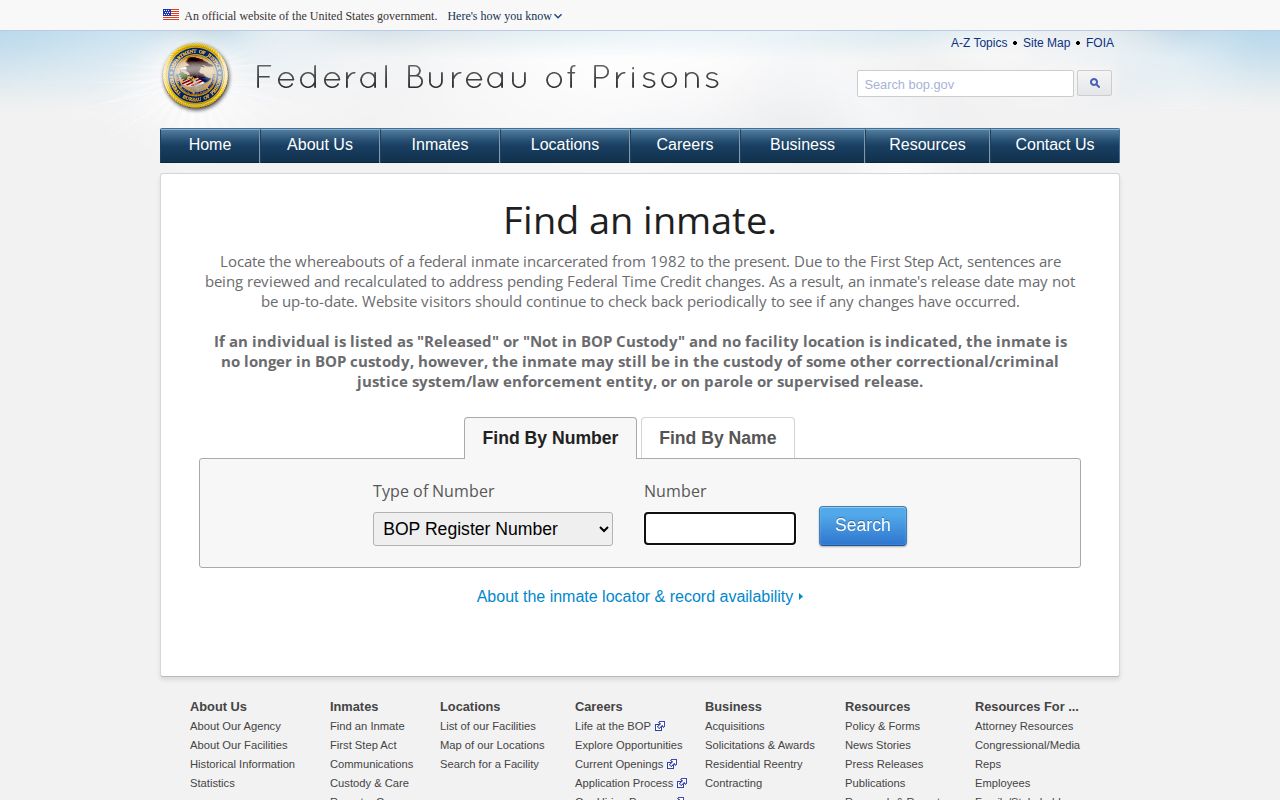
The captured locator shows the federal search route and the type of former-prisoner result that can carry a release date. It does not convert a federal record into an Oklahoma County jail release.
FTC Oklahoma City Release Records
The locator is the fast public check, while the federal criminal case explains the legal sentence. Read the judgment for the prison term, credited custody when stated, and supervised-release provisions. A federal supervised-release term begins after imprisonment under a court order. It is not Oklahoma parole, and the Oklahoma Pardon and Parole Board does not control it.
When a historical document is needed, identify the register number, full name, requested record, and date range. Direct a facility question to FTC Oklahoma City and a sentence or release-history question through the appropriate federal records path. A narrow request is easier to route than a general demand for every file. Some federal information may be restricted, and a public locator result is not a promise that all underlying records will be released.
The appropriate U.S. District Court record, available through federal court systems, should be used for the conviction and supervised-release order. OSCN covers Oklahoma state district cases and does not replace a federal docket. The Oklahoma County released-inmate search is useful only when separate county custody before or after the federal event must also be resolved.
Note: A BOP release date documents the federal custody record but does not by itself describe travel, residence, or another agency’s later action.
FTC Oklahoma City Release Contact
The official BOP facility page is the source for institutional contact. Call with the register number and a narrow routing question. Staff may not disclose protected case, movement, or personal information by telephone. The locator remains the proper public route for a current institution or historical BOP release date.
Federal Transfer Center Oklahoma City7410 S. MacArthur Blvd.
Oklahoma City, OK 73169
405-682-4075
Hours: verify with BOP before visiting
The official FTC Oklahoma City page confirms the federal facility identity and contact. It should not be used as a roster. Do not direct a federal register-number inquiry to OCDC or ODOC merely because all three systems have facilities in Oklahoma City.
Mailing, visiting, legal, and public-information contacts can serve different tasks. Use the channel that owns the requested information. A facility switchboard can route an operational question, but it may not provide a narrative release history or confirm details that the public locator omits.
FTC Oklahoma City USMS Custody Records
The U.S. Marshals Service moves federal pretrial and sentenced prisoners for court and designation. A person can be absent from FTC Oklahoma City because of a writ, hearing, medical movement, or transfer while federal custody remains intact. USMS does not publish a public roster that works like a county jail search.
Use the federal case for court activity and the BOP locator after designation or movement data updates. A local observation or unanswered facility call is not proof of release. If a person briefly appears in a county jail under federal authority, the county booking may document local physical custody, but the federal case still controls the underlying federal detention.
The official USMS prisoner information explains the federal agency’s role and the limits on public location information. A Marshals movement can place a person in a local contract facility or in transit without producing a stable public facility listing. Keep the federal case number and register number together so the court event is not mistaken for an end of custody.
Transfer delays can also produce temporary mismatches. Record when each source was checked and avoid turning a short data gap into a release date. The responsible federal authority owns the movement event; the receiving institution confirms continued custody.
Federal Supervision After FTC Release
Federal supervised release is a court-ordered period following imprisonment. It is not the same as parole, probation imposed in an Oklahoma County state case, or ODOC community supervision. The federal judgment states the term and conditions, and the federal probation system administers supervision. A BOP “Released” result can coexist with active supervised release.
A locator result should therefore be framed narrowly. It can show that the person is no longer in BOP custody and may provide a release date. It does not prove that all federal sentence obligations ended. Read the judgment and later federal docket entries for modifications, violations, or termination. Do not infer supervision solely from the length of the prison term.
Supervision can continue in another district after an approved transfer of jurisdiction or supervision. The person’s location therefore cannot be inferred from the city where FTC once held them. Use the current federal court and probation authority for an active supervision question, and keep that inquiry separate from the historical BOP release date.
- BOP release
- The person is no longer held in Bureau of Prisons custody under the displayed result.
- Supervised release
- Federal court-ordered community supervision following imprisonment.
- Transfer
- Movement between custodial locations while detention or imprisonment continues.
- Writ movement
- Temporary movement for a legal proceeding without ending custody.
FTC Oklahoma City Release Transport
The official visiting supplement identifies commercial transportation in the area, but a visitation document does not promise transportation at discharge. It does not establish that FTC provides a ticket, a particular route, a set exit door, or a pickup location. Confirm any release-day plan directly through authorized federal channels.
Federal regulations can address release planning or gratuities in federal custody, yet they must not be generalized to OCDC or ODOC. Individual eligibility, resources, destination, and agency decisions may matter. Avoid making a travel promise from a general rule.
A family member should not assume that an estimated date is a pickup time. Court action, facility processing, another hold, and movement logistics can alter the actual event. A past locator date is useful historical evidence, not a live transportation schedule.
FTC Oklahoma City Release Systems
OCDC, Clara Waters, and FTC Oklahoma City represent county, state, and federal custody within one metro area. Their records are separate. OCDC uses a booking number and current county roster. ODOC uses a DOC number and statewide offender record. BOP uses a federal register number and national locator.
A departure from one system may be entry into another. OCDC can transfer a person under federal authority. Clara Waters can transfer a state prisoner within ODOC. FTC can move a federal prisoner to another BOP institution. Geography never supplies the legal custodian.
Start with the case type and identifier, then use the matching system. If two systems show activity, build a timeline from source dates and receiving locations. Describe return to the community only when the agency that controlled custody reports a release event that supports that conclusion.