
Where OCDC Releases Go
Oklahoma County Detention Center records several kinds of custody exits. Bond, own recognizance, an approved pretrial release, dismissal, time served, or completion of a county sentence may end with a return to the community. Each route has a different legal basis. Bond generally leaves the charge pending. Own recognizance, often shortened to OR, allows release without the same cash or surety process and may carry conditions. Time served means the custodial term was credited or completed, but other court duties may remain.
An OCDC exit can also be a transfer. A person sent to the Oklahoma Department of Corrections, another county, the U.S. Marshals Service, the Federal Bureau of Prisons, ICE, or a hospital has left OCDC but has not necessarily regained freedom. That is why a request for only the release date is too narrow. Ask for the release type, destination, receiving agency, and release code. Those fields separate a community release from a change of custodian.
OCDC Current Roster Limits
The official OCDC inmate-search page expressly describes JailTracker as a search for current inmates in custody. A matching record supports present OCDC custody at the time of the update. A miss does not provide a release date, release reason, or destination. It may reflect a transfer, a spelling variation, processing delay, or the absence of an OCDC booking.
The separate current daily blotter is useful for connecting a recent booking to a date or booking number. OCDC does not advertise it as a rolling list of released people, and it makes no promise that a former detainee remains visible for a fixed period. Preserve identifiers while a record is current. After it disappears, switch to past-booking records instead of treating the empty result as final proof.
The official current-inmate description can be reviewed before opening the vendor roster.
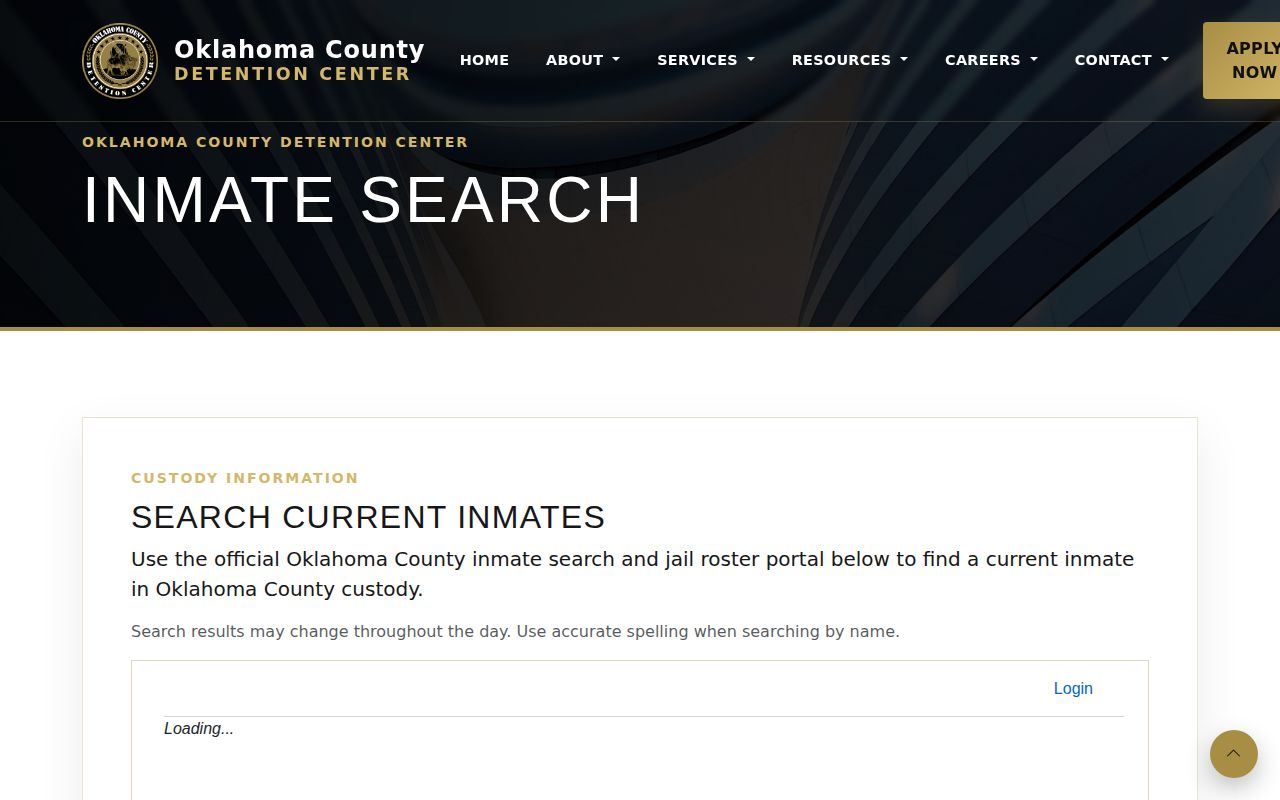
Its current-custody wording is the reason a historical OCDC release must be verified through a different channel.
Confirm an OCDC Release
A strong Oklahoma County release check joins records from the offices that created each event. OCDC owns the physical jail exit. The court owns the bond, dismissal, sentence, or other judicial order. A receiving agency owns the next custody entry. Keeping those roles separate prevents a court order from being mistaken for a completed exit and prevents a transfer from being described as community release.
- Search JailTracker by the exact name and save the booking number, charge, and case number if a current result appears.
- Review the daily blotter for a recent booking trail, while remembering that it is not a released-person feed.
- Search the OSCN Oklahoma County docket by case number for bond, dismissal, sentence, transport, warrant, or disposition entries.
- Request OCDC past-booking and release data, including the exit time, release code, and destination.
- If the record names ODOC, BOP, ICE, or another county, continue in that receiving system with the matching identifier.
The broader Oklahoma County released inmate search explains how those state and federal paths fit together. For the OCDC event itself, give the jail record the most weight on the exact time of physical departure.
OCDC Release Record Fields
Past-booking material may be spread across an intake sheet, booking summary, movement log, release authorization, image file, and property form. A focused request is easier to process than a demand for every record held under a name. Supply a date range and known identifiers. Then identify the exact fields needed to tell the custody story.
| Field | What it establishes |
|---|---|
| Booking number | Connects the request to one OCDC custody episode. |
| Admission date and time | Shows when that booking began. |
| Release date and time | Records when OCDC custody under that booking ended. |
| Release type or code | Identifies bond, OR, time served, dismissal, transfer, or another recorded reason. |
| Destination or agency | Distinguishes return to the community from continued custody elsewhere. |
| Charge and case number | Links the jail event to the court record. |
A booking image may be requested through the same OCDC records route. Its existence does not show guilt or explain the result of the case. It is an intake record tied to a specific booking.
OCDC Records and Contact
OCDC is operated by the Oklahoma County Criminal Justice Authority, often called the Jail Trust. It is not simply a sheriff-run jail. That governance point affects record routing. The OCDC records channel is the first custodian for detention-center intake, booking, movement, image, and release records. The sheriff remains relevant to warrants, transports, and law-enforcement records it separately creates.
Oklahoma County Detention Center
201 North Shartel Avenue
Oklahoma City, OK 73102
405-907-1930
405-504-6811
Lobby: daily, 7 a.m. to 6 p.m.
Email: records@okcountydc.net
The official OCDC contact page provides the records route and current lobby details. The Oklahoma County open-records portal also lists Detention Center General Counsel. Send one precise request first. Duplicate submissions can slow routing. Ask for a cost estimate when copies or a broad search may produce charges, and verify public access before travel.
Note: Lobby hours describe public access, not a promised release time, exit door, or place where family may wait.
Oklahoma County Custody Systems
Oklahoma City contains county, state, and federal custody facilities, yet those systems do not share one release record. OCDC uses a county booking number. Clara Waters Community Corrections Center is an ODOC site tracked by DOC number. FTC Oklahoma City is a federal transfer center tracked by BOP register number. Similar locations and a physical departure do not make those records interchangeable.
| Departing system | Correct confirmation source | What departure may mean |
|---|---|---|
| OCDC county custody | OCDC release record and OSCN | Community release or transfer |
| ODOC state custody | ODOC Offender Lookup and state records | Parole, discharge, placement change, or transfer |
| BOP federal custody | BOP Inmate Locator | Federal release, court movement, or transfer |
If OCDC lists ODOC as the destination, search the ODOC Offender Lookup after processing. If a federal agency is named, use the federal register number. Never force an OCDC booking into the wrong locator merely because all three facilities sit within Oklahoma County.
OCDC Orders and Exit Timing
A court order and a completed OCDC release are related but separate events. OSCN may show an order that reduces bond, authorizes OR release, dismisses a charge, credits time served, or imposes a sentence. The signed order explains legal authority. OCDC still must complete its own checks before physical departure. Staff may need to confirm identity, review holds, process property, and record the final movement.
For that reason, an order entered today does not supply the exact exit time. It also may not overcome another active case or detainer. Pair the court entry with the later OCDC release timestamp. If the timestamp exists but the destination is unclear, ask for the movement or destination code. When several cases appear, compare each case number rather than assuming one order resolves every basis for custody.
- Detainer
- A request or legal basis for another agency to take or hold the person.
- Remand
- A court direction returning a person to custody.
- Discharge
- An end to the custodial or supervisory duty identified in the controlling record.
Leaving OCDC After Release
OCDC sits downtown, but no cited policy promises transportation, a bus voucher, a certain exit door, or permission to wait at a particular curb. Release processing can change because of safety needs and facility operations. A person arranging a ride should confirm the completed exit first and ask OCDC what current pickup instructions apply.
For public transit planning, EMBARK publishes its current system map and schedules. Check service on the travel day. Route times and nearby stops can change, and a map does not identify the facility’s approved release point. This logistical step belongs after custody has been confirmed as a true community release, not after a roster miss or an unprocessed court order.
Families should also keep the person’s identifiers separate from travel plans. A booking number confirms the OCDC episode, while a court case number explains the legal proceeding. Neither guarantees that processing is complete. If VINE is being used for a custody alert, register before the expected movement and compare any notice with OCDC’s own record. OCDC also maintains a local Victim Notification List through its front desk. A notification can flag a reported status change, but it does not replace the release sheet when the exact destination or time matters.