
No Verified Oklahoma County 24-Hour Feed
The Oklahoma County Detention Center, or OCDC, provides two useful official views, but neither is a 24-hour released-inmate list. Its inmate-search page sends users to JailTracker for people who are currently in custody. Its daily blotter page presents the most recently published detention or booking report. OCDC does not promise that either view retains a former detainee for a day, and it does not identify a rolling release window.
That distinction changes the first step. Use the live roster to establish current OCDC custody at the time checked. Use the blotter to preserve a recent booking trail and any identifier shown in the report. Then obtain the release event from OCDC records, VINE, or another system that owns the next custody event. Do not copy names from the roster and describe them as people who got out today.
The same rule protects accuracy when the blotter and live roster appear to conflict. Each is a snapshot with a different purpose, so neither can supply a missing release reason or destination on its own.
How to Check Oklahoma County 24-Hour Releases
Build a same-day answer around one person and one booking. Keep the time of each check because the roster, blotter, court docket, and VINE can refresh on different schedules. If the question concerns a named person rather than all recent movement, the broader Oklahoma County released-inmate search path explains how to reconcile county, state, municipal, and federal sources.
- Search the official OCDC inmate-search page by the exact name. If there is a current match, save the booking number, case number, charge, and bond details that are shown.
- Open the official OCDC daily blotter. Treat it as a dated booking or detention report, not as a release feed, and retain its report date.
- Check OK VINE through VINELink or call 1-877-654-8463. Match the reporting agency and identifier, then compare the event time with the OCDC result.
- Search the OSCN docket for the Oklahoma County case. A bond order, dismissal, sentence, or transport entry can explain authority for movement, but it may not record the physical exit time.
- If the name left the roster, ask OCDC for the booking and release data, including the release date and time, release type, and destination or receiving agency.
A newly processed release can appear in one system before another. When sources conflict, the jail owns its physical exit record, the court owns the judicial order, and the receiving agency owns the next custody status.
What an Oklahoma County 24-Hour Record Shows
Because there is no official same-day release feed, the table describes what to assemble from OCDC’s historical response and related official sources. The information can be split among an intake sheet, booking summary, movement log, release authorization, and court docket.
| Field | What it shows |
|---|---|
| Name and identifier | Connects the event to the correct person and booking; a name alone is not enough. |
| Admission date and time | Marks when OCDC accepted custody for that booking. |
| Release date and time | Records when OCDC control under the booking ended. |
| Release type or code | May identify bond, recognizance, time served, dismissal, sentence completion, or transfer. |
| Destination or receiving agency | Separates a return to the community from continued custody with ODOC, another jail, or a federal agency. |
| Charge and case number | Links the booking movement to the correct OSCN or municipal court matter. |
| Booking image | May be requested as an OCDC image, but it does not prove guilt or release. |
Ask for the smallest record set that answers the question. A release date without the destination can be misleading because OCDC may close its portion of custody when another agency takes control.
Release labels also need context. Cash or surety bond means the bond was posted and processed, not that the charge ended. Own-recognizance or pretrial release can carry conditions. Time served or sentence satisfied describes the custodial calculation, though costs, supervision, or other orders may remain. A dismissal of one charge does not clear another case or hold. “Transfer to ODOC” means state incarceration continues, while escape or walkaway is never a lawful release.
Oklahoma County’s Roster Is Current-Only
OCDC’s own wording says JailTracker searches “current inmates in custody.” The separate blotter page promises only the most recently published report. Neither official page states a post-release retention period or a 24-hour display rule. This is a strong local reason to preserve an identifier while a booking is visible and move to past-booking records after it disappears.
The accompanying image comes from the official OCDC inmate-search source and documents its current-only description.
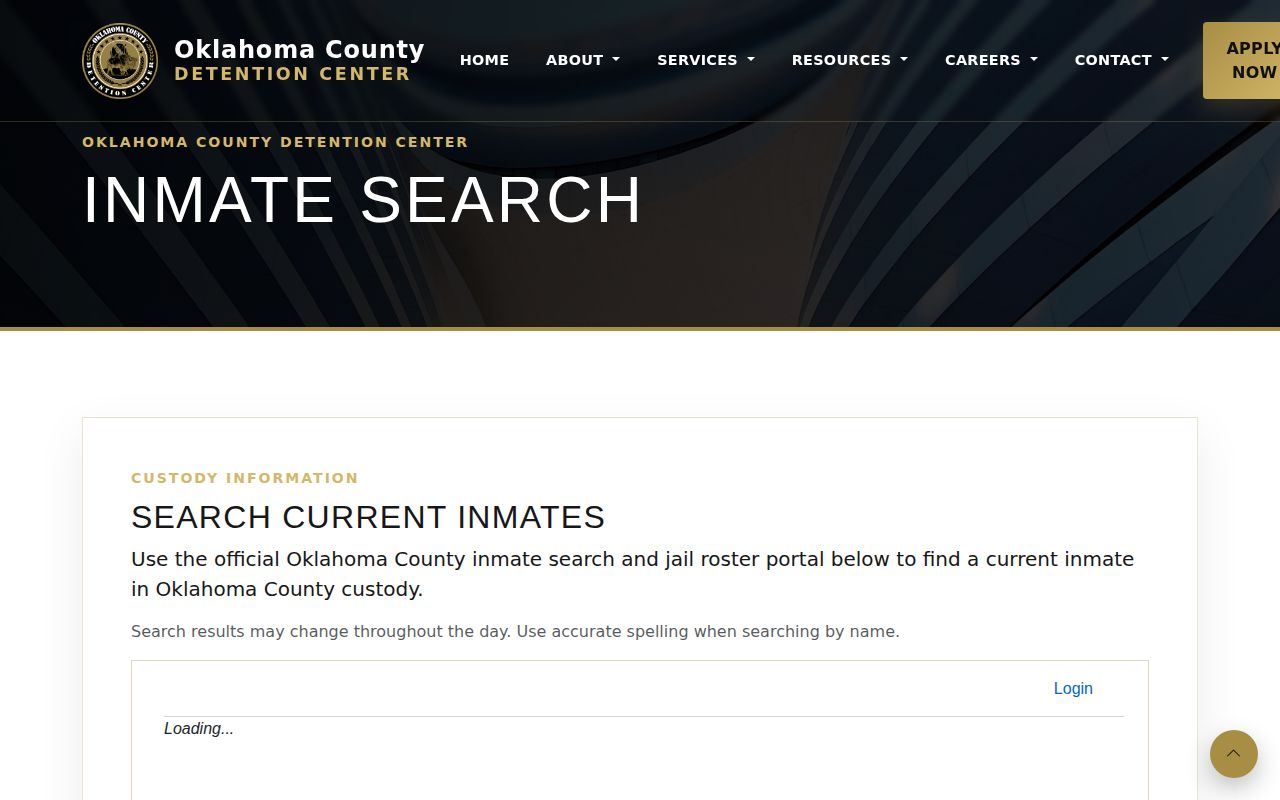
The screenshot documents the limit of the roster itself. It does not identify who was released or explain where a former detainee went.
A roster miss is a lead, not a release record; confirm the OCDC exit and its destination with the agency that recorded the movement.
Released or Still in Oklahoma County Custody
A current OCDC roster match supports current county custody at the displayed update time. A county release record showing bond, recognizance, dismissal, time served, or sentence completion may support a physical return to the community, but each label has limits. Bond and pretrial release usually leave the charge pending. A court order can authorize release before jail staff finish detainer checks, identity processing, property return, and the actual exit.
Transfer is different. An OCDC record can close when the person moves to ODOC, another county, BOP or U.S. Marshals custody, or another authority. Search the ODOC Offender Lookup for a state sentence. Use the BOP locator for federal custody. If a municipal jail made the original booking, contact that police records unit and municipal court because the person may never have entered OCDC.
What proves a same-day release? The best evidence names the person, booking identifier, release date, release type, and destination. An OSCN order can explain the legal basis, while OCDC’s time stamp confirms when the jail completed the exit.
Keep identity control throughout the check. Search documented spelling variants and suffixes, but compare age or date of birth, booking number, charge, county, and case number before joining two results. A cached page, social post, bond receipt, or blank search does not supply the same proof as an agency event tied to the correct booking.
Oklahoma County Pretrial Release Path
Oklahoma County Court Services has a Pretrial Release unit. That creates a local route distinct from posting cash or surety bond, receiving a dismissal, or completing a sentence. Approval may include conditions and does not end the criminal case. It also should not be treated as proof that OCDC has completed the physical release.
Confirm the court authority through the Oklahoma County Court Services context and the OSCN docket, then verify the actual exit with OCDC. When a family hears that pretrial release was approved, the careful statement is that release was authorized subject to processing and any other holds, not that the person is already outside.
Getting Home After an OCDC Release
OCDC is at 201 N. Shartel Ave. in downtown Oklahoma City. A person arranging a ride or transit should check conditions on the day of release because the official sources do not promise a particular exit door, curbside waiting area, bus voucher, or release time. The EMBARK system map and schedules can help with current trip planning, but a route or stop should not be assumed without checking the live planner.
Release authorization and departure can be separated by administrative work. Family members can call OCDC at 405-907-1930 or 405-504-6811 and ask whether the person remains in custody and what source can confirm the completed exit. The lobby is listed as open daily from 7 a.m. to 6 p.m., though travel should be checked against holiday or emergency access.
No Oklahoma County Sheriff Release App
No OCDC or Oklahoma County sheriff mobile app with a recent-release feed or mugshot gallery was verified. OCDC instead points to the VINELink mobile app for anonymous custody checks and notification registration. VINELink is an official status and alert channel, but it is not an OCDC 24-hour list and should not be labeled as a sheriff app.
For a wider reconstruction across several dates, use the Oklahoma County 72-hour release process. It uses the same official owners but places more weight on dated records, weekend timing, and the absence of a public archive.